Case study
We built the software that runs this agency. Then we shipped it.
OCDBees began as an internal fix for a problem every agency has: knowing what to do next. Ten years of daily production use later, it runs every project we touch — and in November 2026 we took it to the floor at Adobe MAX and put it on sale for $3 a seat.
- 2010
- Agency founded in Jacksonville
- 10+ yrs
- OCDBees in daily production use
- 6 yrs
- Four-day week, fully remote
- $3
- Per user, per month, every feature
- 1024
- Our booth at Adobe MAX, Miami Beach
Ice cold
A four-day week leaves no room for guesswork
When you give back a fifth of the working week, you don’t get to spend Monday morning deciding what Monday is for. Every hour has to be already assigned, already prioritised, and already visible to whoever is covering for whoever is out.
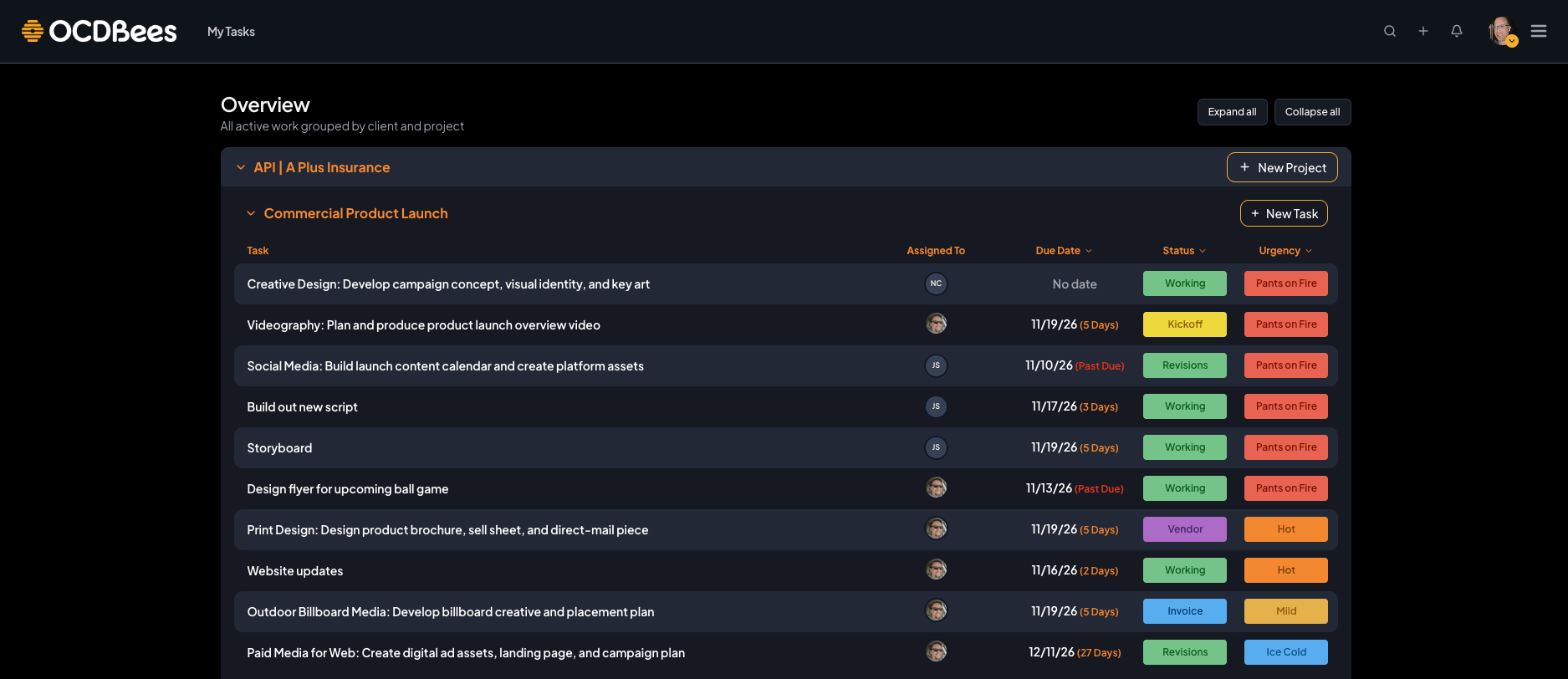
We tried the heavy tools. They were built for software teams running sprints — burndown charts, story points, velocity. An agency doesn’t work that way. A thing is either due Thursday or it isn’t, and somebody’s name is on it or it quietly becomes nobody’s.
What we needed was the smallest system that answers three questions without anyone having to ask them out loud: what is the work, who owns it, and how hot is it. Nothing we could buy answered all three without asking us to run our agency like a software shop.
Mild
Client, project, task. Nothing else.
Three levels, and a refusal to add a fourth. Most project tools fail because they let a team model its org chart instead of its work. Ours can’t — there’s nowhere to put it.
The temperature scale
Ice cold
Real work with no clock on it. Visible, so it never gets rediscovered six months later as an emergency.
Mild
Scheduled and moving on its own. Most of a healthy week lives here.
Hot
Needs attention this week or it slips. The queue everyone checks first thing.
Pants on fire
Drop what you’re doing. Deliberately uncomfortable to say out loud, which is exactly why it stays rare.
Priority is set by the person who owns the deadline, not the person who shouts loudest. That one rule is most of our production management.
Hot
Ten years of shipping to an audience of ourselves
OCDBees first went public as a scrappy startup at One Spark, Jacksonville’s crowdfunding festival, and picked up a small group of local beta users. Then it went quiet for a decade — not because we stopped, but because we were busy using it.
- The methodNo feature shipped because it tested well in a workshop. Every one of them shipped because somebody on this team needed it on a real Tuesday, on real client work, with a real deadline attached.
- The teamStrategist, project manager, creative director, developer, quality assurance. The same five roles we staff client work with — which is the point. Building the product is how we pressure-test the way we run engagements.
- The disciplineThree rounds of production QA in the weeks before launch, each one logged and closed out. Then a hard code lock: no new features between the freeze and the trade show floor. A launch is a bad time to find out what you broke.
- The restraintNo third-party marketing or analytics cookies. We don’t sell or share customer data. Deciding what not to build, and what not to collect, took as long as the rest of it.
Pants on fire
A launch run exactly like a client campaign
We gave ourselves the brief we’d give a client, then held ourselves to the same calendar. Positioning, identity, booth, collateral, press, site, lifecycle email — scoped, assigned and tracked in OCDBees, by the people whose day job is doing it for somebody else.
- PositioningOne sentence everybody on the floor could say the same way: a simple project management tool, three dollars a seat, built by an agency that actually runs on it.
- The floorBooth 1024 at Adobe MAX, Miami Beach, November 10–12. Hundreds of live demos, run by the people who build the thing rather than a hired booth crew.
- The giveawayA small printed booklet called Pants on Fire. Roughly a thousand went out by hand. Nobody needs another branded water bottle.
- The follow-upCapped at two emails: a thank-you, and one note a week later to anyone who hadn’t started a trial. We’re not going to earn a customer by wearing them down.
The product
What you get for three dollars
Every feature is included at every price. There’s no tier that unlocks the useful part, and no per-seat maths that punishes you for adding the intern who needs to see the schedule.
Slack
Task updates land where the team already is, so nobody has to remember to go and look.
Your own storage
Attach files through Google Drive, Dropbox or Amazon S3. Files stay in your account, and we don’t charge you to store them.
ChatGPT and Claude
Ask what’s on fire, review a workload, summarise a project, or draft task updates for your approval — in the assistant you already use.
Why
Make more time for good
The four-day week gives this team time for family, community and a life outside work. OCDBees is a large part of how that holds together — it’s what keeps a short week from turning into a frantic one.
We’d like that to reach further than our own calendar. As OCDBees grows, our aim is to direct a portion of its profits toward organisations doing good in their own communities — the kind of local work this team already gives its own time to.
We’ll bring the same discipline to your work
We built a commercial product, ran it through QA, branded it, launched it at a national conference and kept a full client roster moving — on four days a week. That’s the process we’re selling. OCDBees is just the receipt.
Scope of work
- Strategy
- Positioning, pricing, go-to-market planning
- Brand
- Identity, naming system, voice, print collateral
- Product
- UX, UI, interaction design, onboarding
- Engineering
- Full-stack development, integrations, infrastructure
- Quality
- Production QA cycles, release management
- Campaign
- Trade show design, public relations, lifecycle email, web